

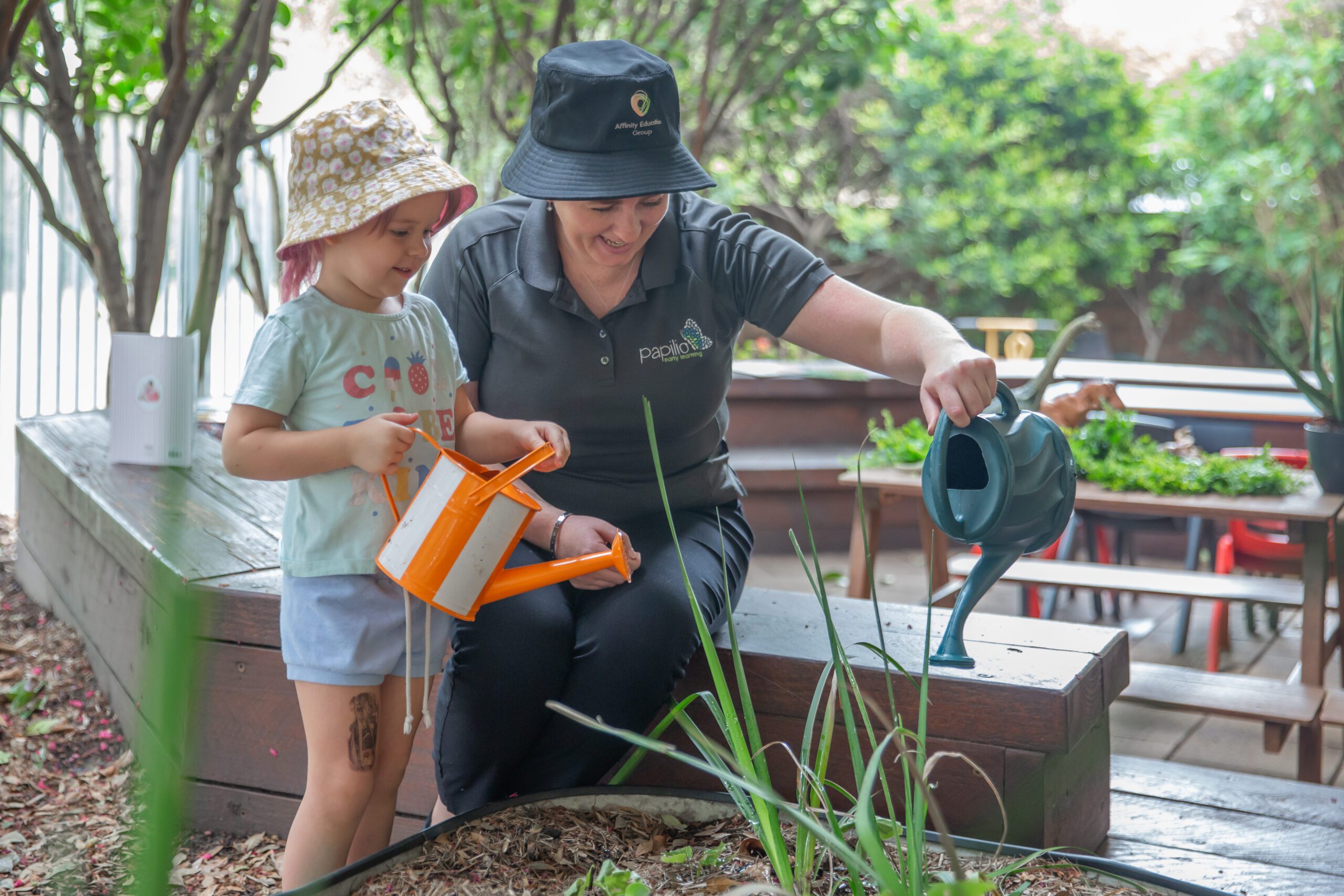

Choosing a premium early learning environment means asking premium questions. Not just “is it nice?” or “is it convenient?”, but “who, specifically, is responsible for my child’s development, and what do they know?”
At Papilio, we think that’s exactly the right question to ask. Here’s a clear, detailed answer.
A highly regulated profession
Early childhood education in Australia operates under the National Quality Framework, a rigorous national system that sets minimum standards for educator qualifications, educator-to-child ratios, educational programming, and centre governance. These aren’t guidelines. They’re legal requirements, independently assessed and publicly reported.
What this means for your family: the team caring for your child has met a defined professional standard before they ever set foot in a Papilio room.
The qualification framework explained
There are three levels of qualification within the early childhood profession, each with a distinct scope of practice.
- Certificate III in Early Childhood Education and Care is the entry-level qualification. Educators at this level have studied child development, health and safety, learning through play, and how to support children’s physical and emotional wellbeing. They work directly with children across all age groups and are an important part of every centre team.
- Diploma of Early Childhood Education and Care represents a significant step up in both knowledge and responsibility. Diploma-qualified educators have deeper expertise in curriculum planning, developmental theory, and team leadership. In practice, they typically hold room leader positions, designing and overseeing the learning environment for their group, mentoring less experienced colleagues, and ensuring the program responds to each child’s individual needs.
- Early Childhood Teacher (ECT) holds a four-year university degree, equivalent in length and depth to a primary school teaching qualification. ECTs are responsible for the educational program at a centre or room level. They conduct developmental observations, plan intentional teaching experiences, and ensure the program is grounded in the latest evidence on how young children learn. Under the National Quality Framework, centres must have access to an ECT, and at Papilio, Early Childhood Teachers are an integral part of how we deliver a genuinely exceptional program.
Educator-to-child ratios: what the law requires, and what we do
Ratios define how many qualified educators must be present for a given number of children. They’re set by national law and vary by age group:
- Under 24 months: one educator for every four children
- 24-35 months: one educator for every five children
- 36 months and over: one educator for every eleven children
These are the legal minimums. They exist because the quality of care and education a child receives is directly tied to the attentiveness of the adults around them, and attentiveness requires time. The right ratio means your child is genuinely seen: their questions answered, their progress noticed, their individual pace respected.
What professional excellence looks like in practice
Qualifications matter because of what they enable in the room. A Diploma-qualified room leader at Papilio doesn’t simply supervise children, they craft a learning environment with intention. The materials on the table, the provocations in the space, the conversations they initiate - these are pedagogical decisions informed by years of study and practice.
An Early Childhood Teacher reviews your child’s developmental observations and adjusts the program accordingly. If your child is showing particular curiosity about the natural world, that becomes a thread woven through the coming weeks. If they’re working on a particular social skill, the ECT designs experiences that support that growth without your child ever knowing it’s happening.
This is what distinguishes early childhood education from childcare in the most basic sense, and it’s what Papilio is built on.
Continuous professional development through the Affinity Learning Academy
Qualifications are the foundation. What happens after that matters just as much.
Papilio educators have access to the Affinity Learning Academy, a dedicated professional development platform that supports ongoing learning, upskilling, and qualification pathways for educators across the network. Through the Academy, educators stay current with emerging research, develop leadership capability, and pursue higher qualifications while continuing to work.
For families, this means the team caring for your child isn’t standing still. They are, in the truest sense, lifelong learners themselves.
Questions that distinguish good centres from exceptional ones
When you visit a Papilio centre, or any early learning centre, these questions will quickly tell you a great deal:
- What proportion of your educators hold a Diploma qualification or above?
- How is your Early Childhood Teacher involved in the daily program, not just documentation?
- How does the centre invest in ongoing professional development?
- What is your approach to educator consistency, and how do you manage transitions between rooms?
The quality of the answers will tell you as much as the answers themselves.
The standard your child deserves
At Papilio, we don’t treat educator qualifications as a compliance exercise. We treat them as the foundation of everything we offer. The expertise in our rooms is what makes the warmth meaningful, because care that is also knowledgeable is care that genuinely makes a difference.
If you’d like to know more about the team at your local Papilio centre, we’d welcome the conversation.