

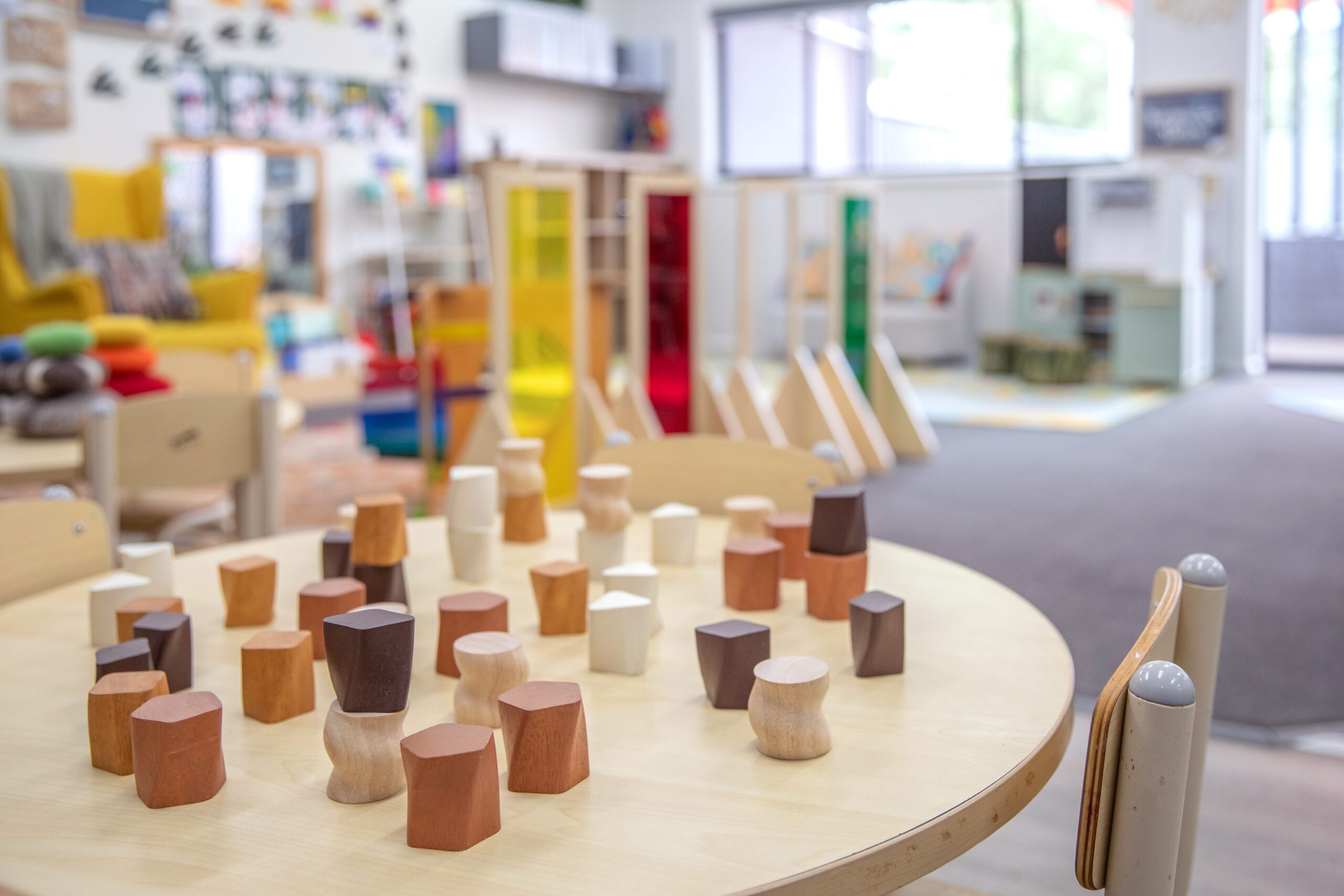

Ask a child what they did at childcare today and the answer is almost always some variation of "played." Which is, to be fair, entirely accurate, and also a significant understatement.
What happens in a quality early learning environment isn't separate from play. It is play, shaped by educators who understand the developmental science behind every activity they design, every question they ask, and every moment they choose to step back and let a child work something out for themselves.
Here's what the research tells us is really happening at each stage, and what that looks like in practice at Papilio.
Babies (0-12 months): The neuroscience of sensory exploration
The first year of life represents the most rapid period of brain development a human being will ever experience. By twelve months, a baby's brain has already formed approximately one million new neural connections per second since birth. What drives that growth? Experience. Specifically, rich, responsive, sensory experience.
When a baby reaches toward a hanging object and grasps it, they are building hand-eye coordination, spatial awareness, and early understanding of cause and effect. When an educator responds to a babble with a warm, attentive reply, matching tone, pace, and expression, they are participating in what researchers call "serve and return" interaction, one of the most well-evidenced predictors of healthy language and cognitive development.
At Papilio, our infant environments are designed deliberately. Textures, contrasts, and carefully curated materials invite curiosity without overstimulation. Educators narrate the world as they move through it, not for the sake of it, but because language-rich environments in infancy lay the neural groundwork for literacy years before a child picks up a book.
Tummy time isn't just physical exercise. Looking at faces isn't just sweet. Every sensory experience in the first year is the curriculum.
Toddlers (1-3 years): Symbolic thinking, movement, and the science of pretend
The toddler years are frequently misread. The emotional intensity, the relentless motion, the fierce attachment to routine, these are not obstacles to learning. They are the learning.
From around eighteen months, children begin to engage in symbolic play: using one object to represent another, taking on roles, building narratives. A cardboard box becomes a rocket. A blanket becomes a patient on an operating table. This capacity for symbolic representation is a major cognitive milestone, the same cognitive leap that underlies language acquisition, mathematical thinking, and creative problem-solving.
At the same time, toddlers are learning through their bodies in ways that directly support later academic skills. Balance and coordination build the proprioceptive awareness that supports sitting still in a classroom. Fine motor play, threading, tearing, moulding, drawing, develops the hand control needed for writing. Movement is not a break from learning at this age. It is the medium through which learning happens.
The Lifelong Learning Curriculum that guides every Papilio room is built on this understanding. Educators working with toddlers aren't simply managing behaviour and facilitating play, they are making intentional decisions about the environments, materials, and interactions that will best support each child's developmental trajectory.
Preschoolers (3-5 years): Sustained attention, social cognition, and the power of big questions
By the time children enter the preschool years, they are developmentally ready for something that looks quite different from what came before: sustained, collaborative, concept-driven learning.
This is the age of questions. Why does the moon follow us in the car? What makes thunder? If plants drink water, why can't I? These questions are not random. They reflect a child's rapidly developing theory of mind - the growing understanding that the world has rules, patterns, and explanations, and that those explanations can be discovered.
In a Papilio preschool room, educators work with these questions rather than around them. When children become interested in something - shadows, construction, the life cycle of a butterfly - educators build on that interest over days and weeks, introducing books, materials, and provocations that deepen understanding rather than moving on. This approach, grounded in the Lifelong Learning Curriculum and aligned with the Early Years Learning Framework, develops sustained attention, critical thinking, and the disposition to keep investigating when something is hard.
Social and emotional learning is equally sophisticated at this stage. Preschoolers are learning to manage complex friendships, navigate conflict with growing language, and regulate emotional responses under pressure. Educators support this not through correction alone, but through modelling, narration, and creating the kind of psychologically safe environment where children feel confident to try, fail, and try again.
Why this matters, and what to look for
If you visit a high-quality early learning centre and it looks like children are just playing, that's a good sign, not a concern.
What distinguishes quality is what's happening underneath: the intentionality of the environment, the attentiveness of the educator, the way interactions are designed to extend rather than direct. Look for educators who follow children's lead and ask open questions. Look for environments that invite exploration rather than prescribe outcomes. Look for documentation - learning stories, observations, portfolios - that make visible the growth that isn't always obvious to the outside eye.
At Papilio, we believe families deserve to understand what exceptional early learning looks like, not just be told it's happening. We're always happy to walk you through what a day looks like in each room.