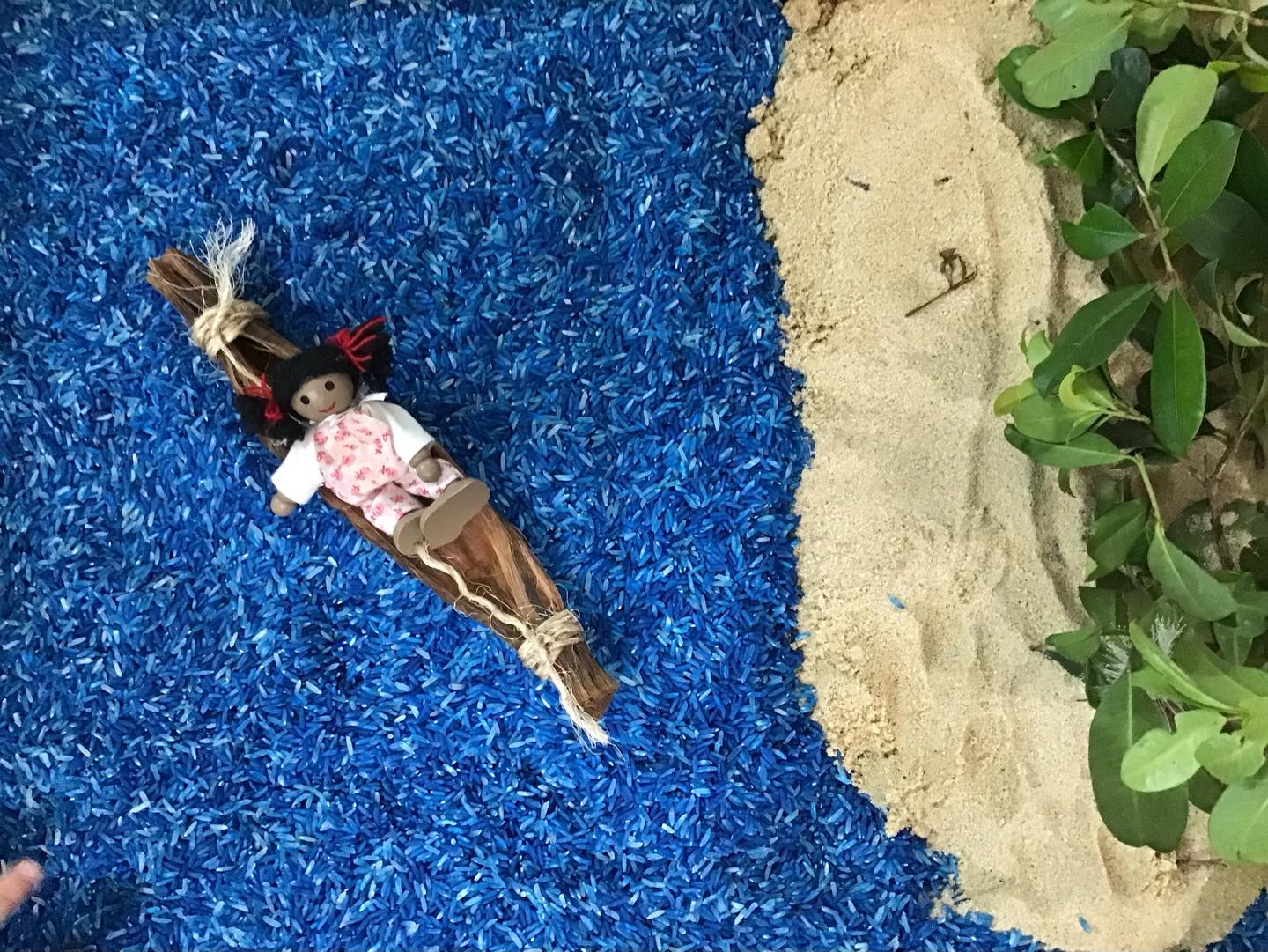

Some of the most profound learning happens not in formal instruction, but in a quiet moment of play, when a child picks up a piece of bark, places a small figure inside, and begins to tell a story.
This month at Papilio Early Learning, children have been exploring the concept of the Nawi, a traditional Aboriginal canoe from the Sydney language region, as part of our Lifelong Learning Curriculum, supported by resources from Wandana Aboriginal Education.
What is a Nawi?
A Nawi is a traditional canoe crafted by Aboriginal peoples of the Sydney region from tree bark and natural materials. These vessels were integral to daily life, used to navigate rivers, lakes, and coastal waters, to fish, gather food, and sustain the connections between communities.
But the Nawi represents something beyond its function. It embodies a sophisticated, lived understanding of Country, knowledge accumulated over tens of thousands of years and carried forward through storytelling, observation, and practice.
A Thoughtfully Curated Learning Experience
At one of our centres, educators created a carefully considered play invitation using natural materials and small figures, offering children the opportunity to imagine their own Nawi journeys.
Where were they travelling? Who was with them? What might they discover?
These open questions opened into rich conversations, children narrating their journeys, negotiating with peers, and drawing on their own emerging sense of story and place. There was no predetermined destination. The experience was designed to follow the child.
This kind of intentional, open-ended provocation is central to the Papilio approach, experiences that are beautiful in their simplicity, and purposeful in their depth.
Authentic Aboriginal Perspectives, Woven Into Daily Life
Each month, our centres are supported by Wandana Aboriginal Education, whose carefully developed resources equip our educators to introduce Aboriginal and Torres Strait Islander perspectives with accuracy, cultural sensitivity, and genuine respect.
These are not add-on activities. They are woven into the fabric of daily learning, present in the materials on the shelf, the stories shared at group time, and the questions children feel empowered to ask.
This approach aligns with national guidance from ACECQA on embedding First Nations perspectives within early childhood education, and complements the Reconciliation Action Plans that our centres are actively working towards or have already implemented.
The Foundations of a Curious, Connected Child
For children in their earliest years, experiences like these do more than introduce a new concept. They build language and narrative thinking, cultivate empathy and perspective-taking, and nurture a genuine curiosity about the diversity of human experience.
These are the qualities that underpin not just school readiness, but a rich and engaged life.
Learning That Endures
At Papilio Early Learning, we believe that exceptional early education is about more than what children know, it's about how they come to understand themselves and the world around them.
Through our partnership with Wandana Aboriginal Education and the expertise of our educators, children are offered experiences that are as intellectually rich as they are joyful. It is in these carefully held moments that the most enduring learning takes root.