


The word "risk" tends to make parents uneasy, and understandably so. But in the context of early childhood development, risk is not the opposite of safety. It is, in fact, a necessary ingredient in children's physical, cognitive, social, and emotional growth.
A substantial body of research now supports what experienced early childhood educators have long understood: children who are given the opportunity to engage with managed risk in play develop more robustly across a range of developmental domains than those whose play is consistently risk-free. Here's what the science says, and how Papilio approaches it in practice.
Defining risky play - a critical distinction
Before examining the evidence, the distinction between risk and hazard is worth establishing clearly. Play Australia's Risky Play Position Statement is unambiguous on this point: risky play is not unsafe play. It may involve some risk of minor injury, but it does not involve hazards that cause serious harm. Adults play an important role in supporting children's engagement in safe risky play while promoting the refinement of risk-management and risk-literacy skills that are critical throughout life.
Risky play encompasses activities with height, speed, and physical challenge; rough-and-tumble play; use of tools; proximity to natural elements such as water, fire, or uneven terrain; and experiences that involve a degree of uncertainty or the genuine possibility of failure. It provides children with opportunities to challenge themselves physically, emotionally, and mentally, to test their limits, make decisions, and learn to assess and manage risk in a controlled and supervised environment.
What the developmental research shows
The evidence base for risky play spans physical development, cognitive function, emotional regulation, and social competence.
Physically, risky play helps children develop strength, coordination, balance, and fine motor skills. It promotes a sense of mastery over their own bodies. Cognitively, it encourages problem-solving and decision-making - children must assess situations, make choices, and adapt their actions based on the challenges they encounter, fostering critical thinking. Emotionally, engaging with risky play allows children to confront and manage fear, anxiety, and stress; overcoming these challenges builds resilience, confidence, and self-assuredness.
A Canadian study examining the effects of risky play in early learning settings with children aged two to five found significant improvements across multiple developmental measures. Researchers observed decreases in depressive states and antisocial behaviour, alongside increases in independent play, prosocial behaviours, self-regulation, creativity, and self-confidence. Notably, injury rates also decreased, a counterintuitive finding that reflects the risk-literacy skills children develop through appropriately managed challenge.
Research has also established that the developmental benefits of risky play extend beyond early childhood into adult life, making the case for investing in outdoor challenge during the early years not merely as a developmental nicety, but as a long-term health and wellbeing imperative.
The EYLF, NQS, and the evidence for outdoor challenge
Australia's early learning frameworks explicitly support risky play as a component of quality early education. The Early Years Learning Framework (EYLF) articulates under Outcome 1 that children develop autonomy, resilience, and a sense of agency when they take considered risks in their decision-making and learn to cope with the unexpected. Under Outcome 3, the EYLF establishes that challenging outdoor environments are central to children's physical learning and mental wellbeing.
NQS Quality Area 3 requires the physical environment to be safe, suitable, and organised to support children's full participation in the programme, a standard that encompasses, not excludes, well-managed physical challenge.
Rather than designing play environments that are "as safe as possible", the evidence supports designing environments that are "as safe as necessary", ensuring that the benefits of challenge are available to children without exposing them to unacceptable risk of serious harm.
How Papilio approaches outdoor environments and risky play
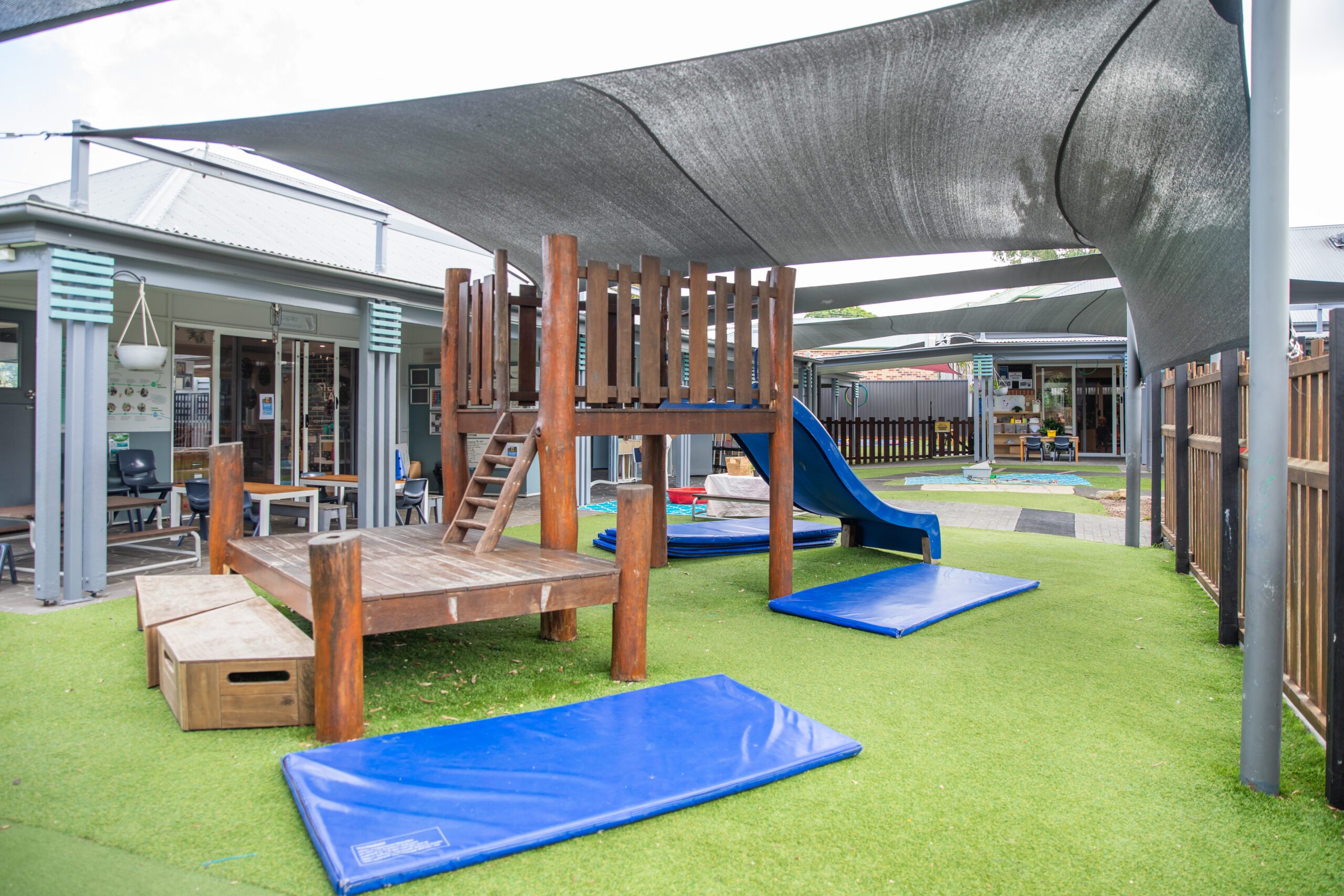
At Papilio, outdoor environments are designed with deliberate intention. Physical challenge is incorporated thoughtfully, through climbing structures, natural loose parts, varied terrain, and materials that invite exploration and problem-solving. The outdoor programme is not supplementary to learning: it is a core context in which some of the most important developmental work of early childhood takes place.
Our educators are trained to apply benefit-risk thinking in practice: considering not only the potential for harm, but the developmental cost of restricting children's access to challenge. This means that at Papilio, educators are empowered to support a child climbing higher than feels comfortable to an observer (within reason), or navigating a tricky physical problem without immediate adult intervention, because the research is clear that this is where the learning happens.
The Lifelong Learning Curriculum underpins our approach to outdoor play across all age groups. From the sensory exploration of natural materials in the infant room, to the complex physical and social negotiations of preschool outdoor play, outdoor challenge is planned, progressive, and developmentally intentional.
Supporting risky play at home - what the evidence recommends
Families can extend the developmental benefits of risky play beyond the centre environment with relatively simple adjustments:
- Prioritise outdoor time in varied environments - parks, bushland, beaches, and neighbourhood spaces all offer forms of natural challenge that structured playgrounds do not.
- Introduce age-appropriate tools - gardening implements, craft knives for older children, simple woodworking equipment. Supervised use builds competence and concentration.
- Tolerate productive struggle - when a child is working through a physical or problem-solving challenge, the developmental value is often in the attempt, not the outcome. Resist the urge to resolve it immediately.
- Widen the risk envelope incrementally - children's confidence grows when adults allow them to extend slightly beyond their comfort zone in environments that are supervised but not controlled.
- Allow natural consequences - minor scrapes, frustrations, and failures are not failures of parenting. They are how children learn to calibrate their own abilities and develop the self-regulation to try again.
Reframing risk as an investment in your child's development
Play Australia's Risky Play Position Statement brings together professionals from medical, educational, and playground design disciplines across Australia to advocate for risky play in children's lives, recognising it as an inherent and critical component of young children's development, and calling for a benefit-risk approach that replaces the current Australian tendency toward risk aversion.
At Papilio, we are aligned with that position. Our commitment is to provide outdoor environments and educational programmes that honour the full complexity of children's developmental needs, including the need for challenge, uncertainty, and the earned satisfaction of overcoming something difficult.